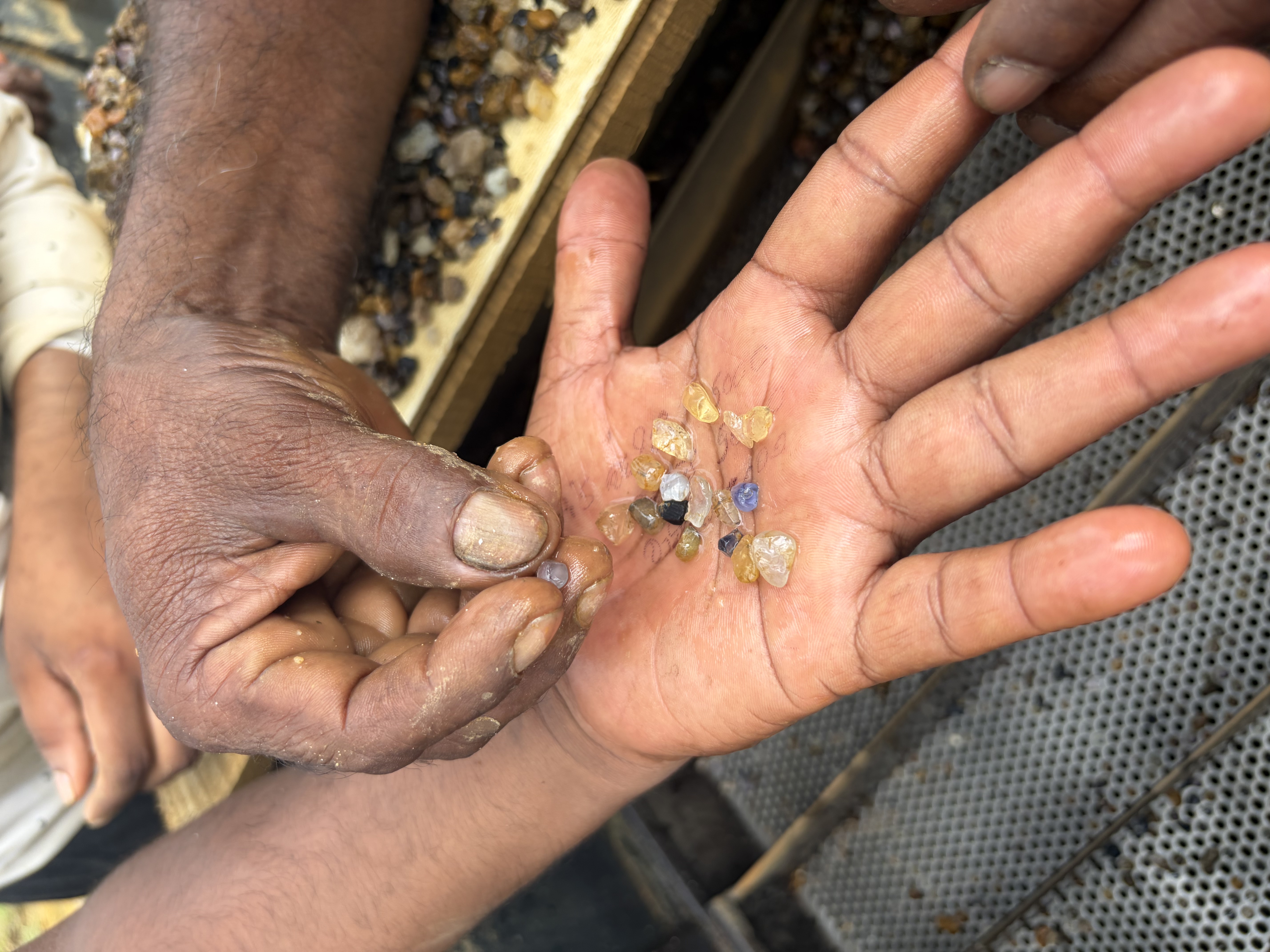
Every gemstone you have ever seen — in a ring, in a case, in a photograph — has passed through a long and often complex journey before it reached that point. Most people, understandably, focus on what a stone looks like when it's finished: the colour, the cut, the brilliance under light. But where it comes from, and how it gets out of the ground, shapes almost everything about it.
Recently I travelled to Hong Kong, Thailand, and Sri Lanka to deepen my understanding of the supply chain from the ground up. This is the first in a series of articles documenting what I found. It begins at the very beginning: the mines.
At the Source
Sri Lanka is one of the most remarkable places on earth for gemstones. An island roughly the size of Ireland, it contains over 70 varieties of gem-quality mineral — sapphires, rubies, spinels, alexandrite, garnets, moonstone, and many others. The gem-bearing geology formed between 500 and 180 million years ago, when tectonic movements created conditions that concentrated minerals in the country's ancient riverbeds and alluvial plains.
Ratnapura, in the south-west of the island, is the centre of it all. Its name means "city of gems" in Sinhalese — which tells you everything you need to know about how long people here have understood what lies beneath their feet. It is one of the most significant gemstone mining regions in the world, and it looks nothing like you might expect.
Three Ways to Mine
Pit Mining
The most common method in Ratnapura involves hand-dug vertical shafts, reaching approximately fifty feet into the earth, with horizontal tunnels extending outward to extract the gem-bearing gravel layer — known as illam — that sits between harder rock formations. Material is brought to the surface, washed in water, and carefully sifted by hand.
I descended into one of these mines. The air was damp and heavy, and the shafts narrow enough that oxygen had to be pumped down from the surface. The conditions were physically demanding in a way that no photograph adequately captures. The people working these mines do so for long hours, with variable income, for stones that will eventually sell at prices utterly disconnected from the labour involved in finding them.
Mechanised Mining
Larger operations use heavy machinery to excavate greater volumes of earth. The material is deposited into vats where workers break it down with high-pressure hoses, then passed through density-separation pumps: heavier stones settle and are collected, while lighter material washes away. It is efficient but removes the intimacy of hand-sorting — the moment when a miner first holds a stone and begins to assess what it might be.
River Mining
The most visually striking method, and the least invasive. Miners wade into the shallows of rivers and streams, scooping gravel from the riverbed into shallow pans and using a hand-swirling technique — very close to gold panning — to separate heavier material. It requires patience and experience. The stones found this way have often travelled some distance from their original deposit, polished smooth by the water.
The Miners
Most miners work on commission from their finds, which means income is entirely unpredictable. A week of work might yield nothing sellable. Or it might yield something extraordinary.
"The stones you end up wearing have passed through many hands, and the first pair worked the hardest of all."
The day before my visit, the team at one of the pit mines I toured had uncovered a 90-carat yellow sapphire. A significant find by any measure. Success stories like this — and they do happen — are what sustain the industry and keep people coming back. Some miners become wealthy gem dealers. Most do not. But the knowledge that the ground beneath you might yield something remarkable is a powerful thing.
Understanding where gemstones come from changes how you look at them. It is not just sentiment. It is about knowing the real cost of what you are holding.