Once a stone comes out of the ground, it needs to be sold. That sounds simple. It is not. How rough gemstones move from mine to the next stage of the supply chain varies enormously — by country, by stone type, by the scale of the operation, and by the relationships involved. In the weeks I spent travelling through Bangkok and Sri Lanka, I saw two versions of this market that could not have been more different.
Bangkok: The Formal Auction
At the Fura Auction in Bangkok, I observed a tightly controlled environment run by Fura, one of the world's major coloured gemstone mining companies. Their operation covers significant ruby and emerald deposits in Mozambique and Colombia, and the auction format reflects that scale.
Lots of sorted rough stones are catalogued meticulously before the auction opens. One lot I examined contained 1,289 padparadscha sapphires — that rare pink-orange variety that commands some of the highest prices per carat in the sapphire market — weighing over 216 grams in total. Each lot is available for inspection in advance. Buyers submit sealed bids. There is no negotiation, no theatre. The highest bid wins.
It is a professional environment populated by serious buyers: large cutting houses, established dealers, representatives of jewellery brands. The stones are graded and sorted before they arrive. The uncertainty has been partially removed — which is exactly what formal buyers are paying for.
Ratnapura: The Roadside Market
Weeks later, in Ratnapura, the rough stone market operated on entirely different terms.
Miners arrive with stones wrapped in paper — folded into small packets the way you might wrap a coin. They sell directly to small buying offices or street dealers who operate from narrow shopfronts and outdoor stalls. When our group arrived, roughly twenty dealers converged quickly, each presenting ungraded rough specimens. Opening prices were wildly inflated. Substantial negotiation was expected by everyone.
"The first price is never the real price and everyone knows it."
This is not deception — it is simply how the market works. The same stone might be offered at five times what the seller would accept, and both parties understand this. The skill is in knowing the difference between a stone that is genuinely rare and one that is merely presented as such.
Reading Rough
This is where formal gemmological training reaches its limits. Everything I learned about identifying and grading gemstones applies to faceted stones — cut, polished, finished. Rough requires a different set of skills entirely: the ability to assess clarity through an uneven, often encrusted surface; to predict how a stone will behave under the cutter's wheel; to estimate yield. These are things you learn through experience, not through textbooks.
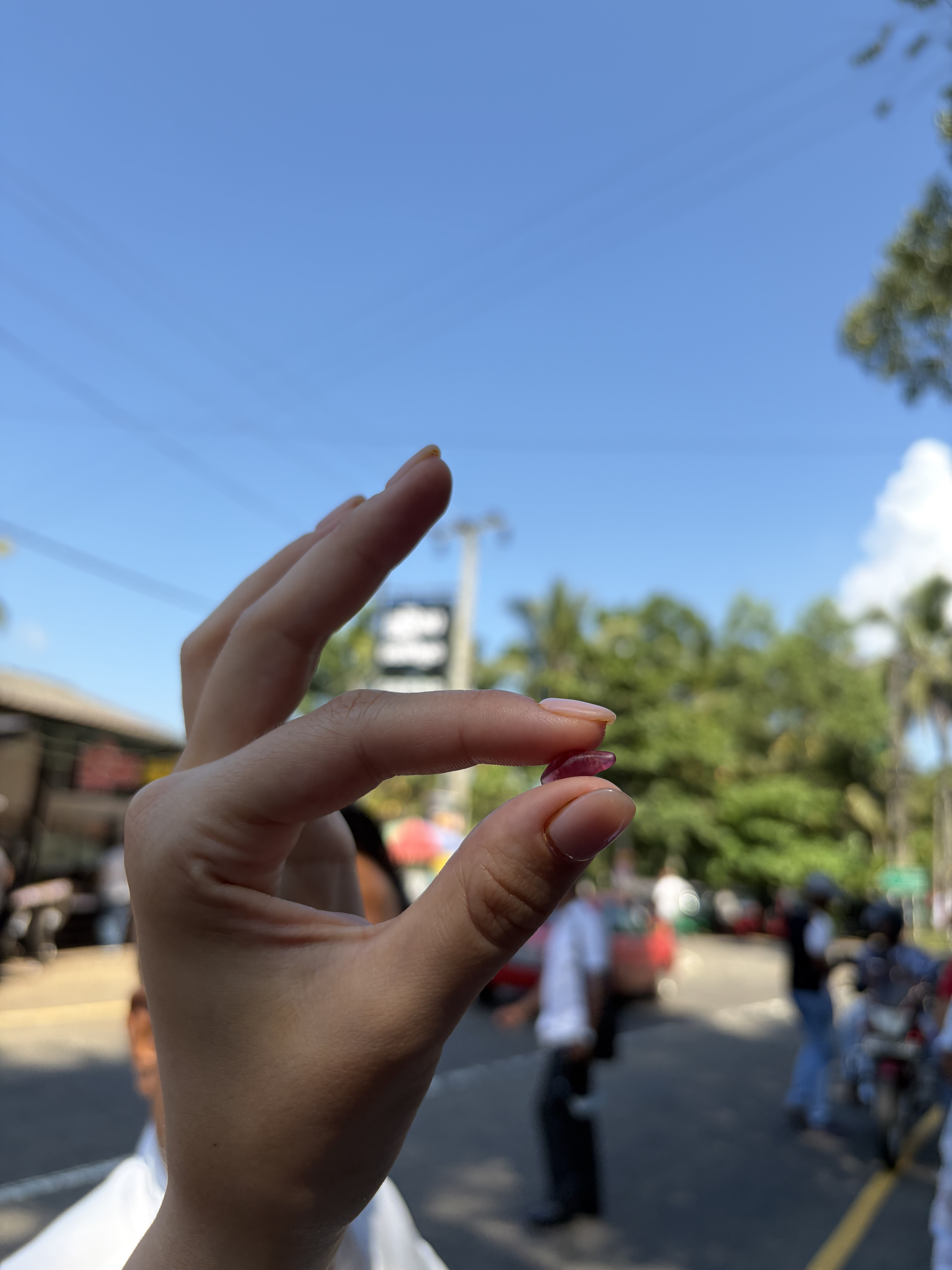
I purchased a rough purple sapphire at one of the Ratnapura markets — identified by one of the dealers, correctly as it turned out, as containing star properties. When the stone was later cut into a cabochon, the asterism appeared exactly as predicted: a six-rayed star, shifting across the surface as the light moved. It was a lesson in how much local knowledge counts for, in a market where that knowledge is not given away freely.
What the Market Teaches You
One detail stayed with me. A roadside dealer I spoke with had attended school with a prominent gem merchant now based in Colombo. The merchant had found a significant stone early in his career and parlayed it into a business. The dealer had not. They had started from the same place; the distance between them had been created by a single stone, a single moment of fortune.
The rough stone market — whether formal auction or informal street trade — is where value first attaches itself to a gem. Understanding how that happens, and what drives the pricing at this stage, changes how you think about every polished stone you encounter afterwards.